Prerequisites
PrerequisitesBefore starting this remote exercise, the students are trained in the following topics:
- Translation
- Revision
- Linguistic QA
- Basic IT
- CAT tools
- Terminology & Tools
- Software Localisation
- Help & Web site Localisation
- Illustrations handling, DTP
- Technical QA
- Project Management, including the following points:
o First Contact with Clients
o Project Analysis
o Budget & Schedule
o Launching the Project
o Monitoring the Project
o Completing Production
o Post-Mortem
o Archiving the Project
Most of these topics are taught to our students as part of their course (M1 and M2).
On the other hand, explanations regarding these topics can be found on eCoLoTrain, as well as on eCoLoRe. This material is very helpful as a support to the above courses, as well as a back up for our students.
For instance, last year, the ICT courses available on eCoLoTrain were included in the PM course. By December, all students had to browse every ICT course in order to make sure they had the complete know-how required to work as professional translators, PMs or even technical engineers.
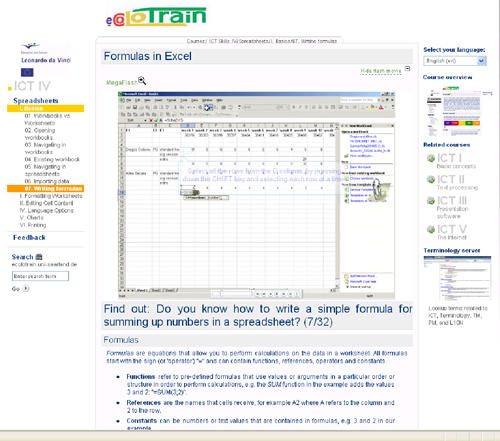
For instance, it is important to make sure that future PMs are competent in the use of MS Excel to create budgets and tracking files.
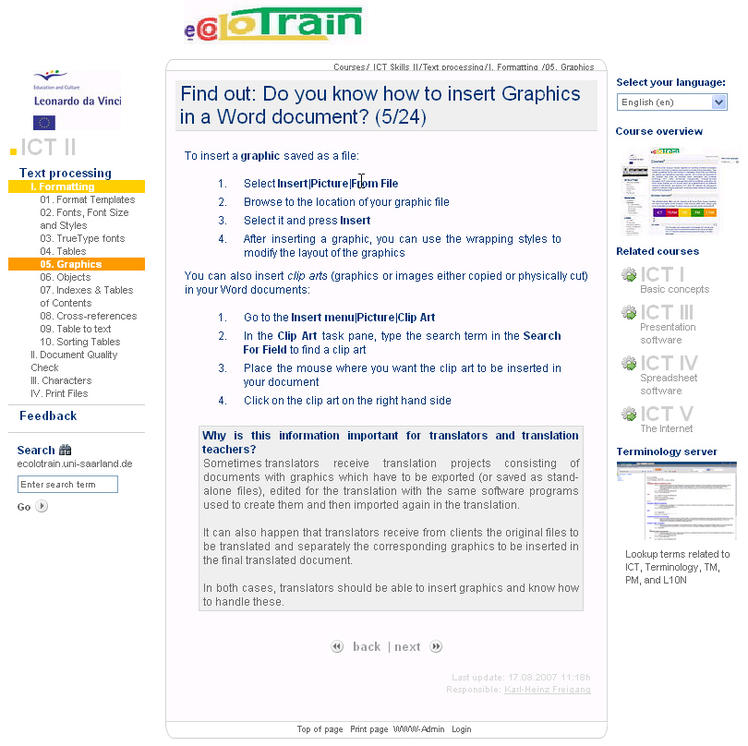
It is also very important to ensure that people who will work in DTP know how to handle templates, fonts, graphics, etc. Even if Microsoft Word is not the only program for DTP, knowing its basic features will help developing one's skills to use other programs like Adobe FrameMaker, Adobe Indesign, etc.
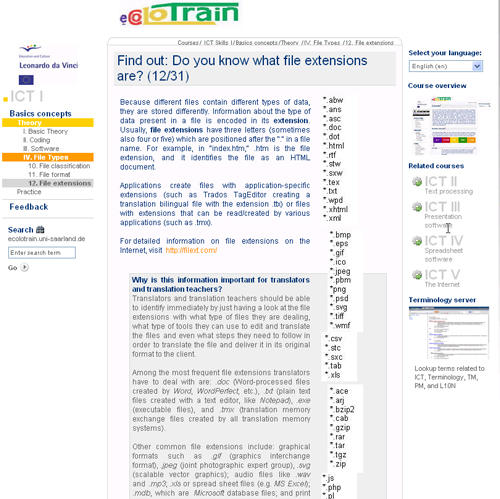
Furthermore, eCoLoTrain also provides links and references to get more information on the various topics.
Making sure all students read these ICT courses is a real must for my own PM course. It is indeed no longer necessary to spend hours on basic explanations useful for my course but not actually part of it.
Second Year Master’s Students are supposed to know a lot already about TM tools and Terminology. Still, it is always useful to read explanations given in a different way. Students are therefore encouraged to visit eCoLoTrain and read everything about TM and Terminology.
Now that eCoLoTrain is completed, the next step will be to ask my future students to read all other eCoLoTrain courses.
Indeed, before starting the PM courses, students are taught about software, web sites, help and documentation localisation.
We introduce them to as many things as possible and do various exercises with them. However, there might be areas that we do not have time to dwell on.
The software localization course on eCoLoTrain is very well presented and quite comprehensive. Consequently, students will be required to read it fully and make sure they master topics like:
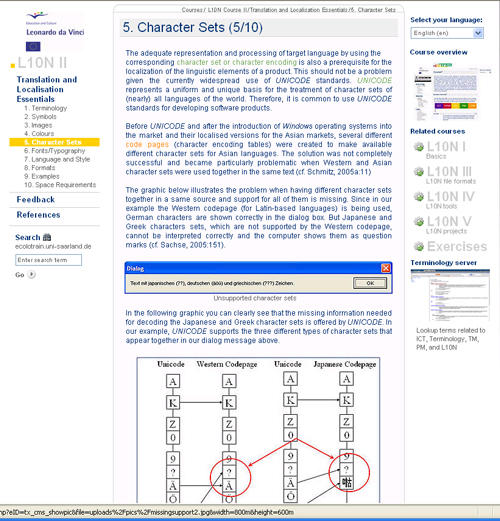
- the importance of character sets:
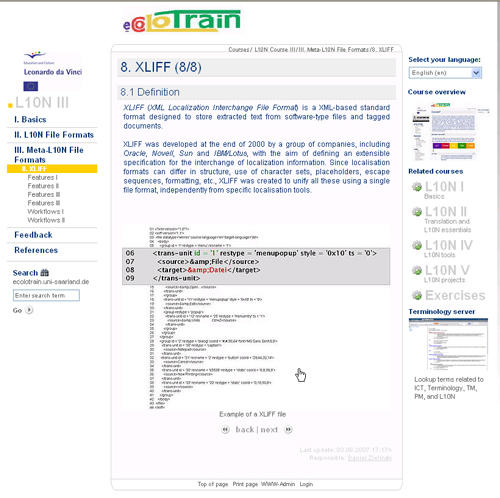
- what xliff is:
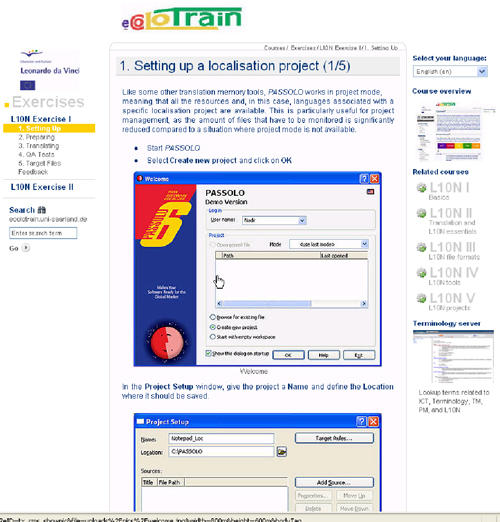
- and use tools like Passolo:
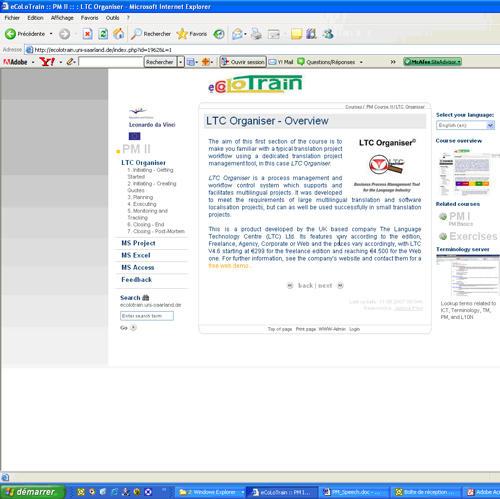
Finally, between the end of the PM course and the launch of the remote PM exercise, they will have to read the PM courses on eCoLoTrain since other ideas than those discussed in class might help them. It will also give them the opportunity to learn about new tools not used during my course, like LTC Organizer: